"The Government is committed to reviewing the UK’s extradition arrangements."
Saturday, 21 August 2010
EU Arrest Warrant does not work - deluded ministers think they have power to intervene (they don't)
Friday, 20 August 2010
Fundamental Rights disappear again (but only for some)
- Right to equal protection under the law
- Right to freedom of thought
- Right to freedom of speech and press (cf. freedom of expression)
- Right to freedom of association
- Right to freedom of movement within the country
- Right to vote in general election
- Right to procreate irrespective of marital status or other classifications
- Right to direct a child's upbringing
- Right to privacy
- Right to marry
- Right to property
- Right to freedom of contract by parties with proportional bargaining power
- Mao, left-wing, killed 70 million people in peacetime, more than any dictator prior to him or until date.
- Stalin, left-wing, killed 23 million people in wartime and peacetime.
- Hitler, left-wing (if you label him right-wing please leave a justification for that in the comments), killed an estimated 12 million people in wartime and peacetime.
- Tojo, left-wing, killed 5 million people in wartime.
- Pol Pot
- Ismael Enver
- ...
Sunday, 18 July 2010
The Virtues of Meritocracy
Great men rise above their peers like the tallest trees of the forrest. Proud, but first to catch the eye, and therefore soonest to be cut down. And down they come with a groan and brief thunder. When they are gone there is only rotten stump and empty space of sky to prove they have ever been there.
Wednesday, 16 June 2010
Talk at the IEA
Friday, 5 March 2010
Tuesday, 23 February 2010
One day...
Monday, 8 February 2010
Turn of the TV - Manly P. Hall's take on the World
Tuesday, 12 January 2010
So much for English Common Law ... as usual the EU is not mentioned once
Moreover, by obliging the Austrian Emperor Francis to renounce the title of Holy Roman Emperor, Napoleon snuffed out an institution that had been at the heart of Europe for more than a millennium.
Napoleon's idea of Europe was double-edged. On the one hand, he overthrew decadent dynasties such as the Bourbons of Naples and established what was to become the model for Continental legal systems, the Code Napoléon. Later, in exile, he claimed that he had "wished to found a European system, a European code of laws, a European judiciary" so that "there would be one people in Europe." Yet, at the same time, Napoleonic Europe was without question an authoritarian empire.
What finally killed Napoleon's Europe was the fatal combination of the English Channel and the Russian winter. Nevertheless, it proved impossible to restore the old pre-Napoleonic Europe.
Napoleon fell; Bonapartism lived on, with the civil code and economic dirigisme as perhaps its most enduring legacies. Now it is back in the UK backed and imposed by the EU as usual (that is one of the 'minor' consequences, one of the footnotes, of signing the Lisbon Treaty), and as usual not a word is being said about this in the newspaper. Not a single 'EU' is mentioned in relation to uprooting of English Common Law. What to say? It is again one of those where you are completely at loss for words. Think back at the greatest men of our history and ponder what they might have replied on stumbling upon this revelation; that the corner stone of England is being chucked out just like that. It should be said that I strongly disagree with Mr. Berlins who wrote this post on the issue over at the Guardian. I will echo instead what Fausty said on the subject.
An illustration of the difference between Common Law and the Code can be seen in the understanding of "Rights." In the Anglosphere, there are a core set that pre-date the existence of the civil power and cannot be diminished by it (Jefferson's "Life, Libery and the Pursuit of Happiness.") The Code acknowledges no rights save those spelled out in the Code itself. Rights are thus a creature of the Code and therefore malleable by whoever has the power to amend the Code.
Monday, 14 December 2009
Free speech? Which one...
By all means say what you think about foreign affairs. Oh, but wait a minute! For goodness' sake don't criticize our fine government, or show disrespect to our brave lads, or risk "giving comfort to the enemy".
Certainly give your free and open views about business and the economy. Oh, but we are facing a recession and huge government debt - so be sure not to "talk Britain down"!
There's always a reason to avoid upsetting people, implying criticism of the great or the good, or lowering public morale. And that can be used as a pretext to prevent the uttering of vital facts and figures.
I prefer the healthy attitude of the American Major General Carl Schurz: "Our country, right or wrong. When right, to be kept right, when wrong to be put right." To respect your enemy is the first step to victory. How could you possibly win against an adversary which you thought inferior to yourself? Every military campaign in the history of military campaigns has stumbled on this lapse of megalomania; Napoleon, Hitler, Vietnam, Stalin, White's vs. Red's and so on and on...
Monday, 20 July 2009
Remember The Awe
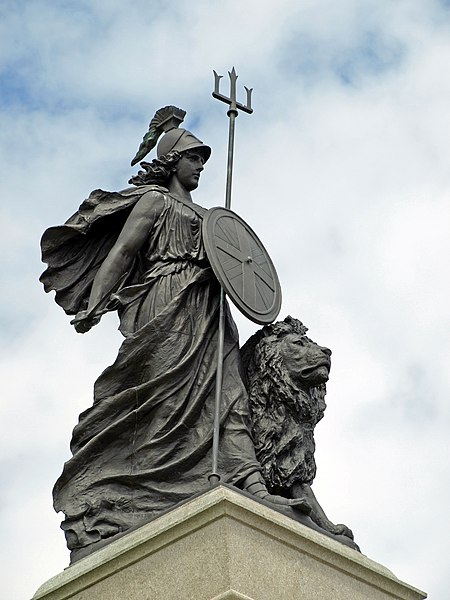
Recall the familiar, if not yet proverbial, tune of Rule Britannia by James Thompson with music by Thomas Arne.
The lyrics of the chorus to the sung version ('Rule, Britannia' is a poem originally), please let me draw your attention to the part in italic...
- Rule Britannia!
- Britannia rule the waves
- Britons never, never, never shall be slaves.
- Rule Britannia!
- Britannia rule the waves.
- Britons never, never, never shall be slaves.
Never, never, never shall Britons be slaves, quite patriotic it is and the tunes of which have reverberated long into this century. It has touched hearts and minds, it has even permeated the darkest depths of political thought for who could well forget Margaret Thatcher's famous "No! No! No!" - speech?
As you might have guessed there is darker tone, a more deleterious background and an altogether lost sense of what the song was written for of what it was supposed to represent.
If we roll back the clock to the time of the Magna Carta Libertatum, signed by King John of England in the year 1215 (actually there is no evidence that King John could write but it did bear his seal). I will again give the readers of this account the benefit of the doubt and assume them scholarly knowledgeable of the Great Charter. Non-believers of this charter seem to think that even though it has been amended through the ages (quite a few times actually) and that it initially only applied to aristocracy and large landowners, makes it defunct today for all swathes of society even aristocracy and large landowners (I hope you can spot the stupidity of this argument even though Lord Mandelson likes to sport himself part of the 21st century aristocracy...) This is the view held by the EU apologist Nosemonkey.
The most famous of its sixty-three clauses said that no free man could be imprisoned, outlawed or exiled except by the lawful judgement of his peers or by the law of the land, and that justice could not be sold, delayed or denied. It also contained clauses relating to the treatment of heirs and widows and to the payment of debts. It provided for uniform measures of wine, ale, corn and cloth throughout the realm. It confirmed the liberties of the Church and of all cities and towns and it sought to regulate the conduct of all local officials such as sheriffs, bailiffs and constables and ensure that they knew and observed the law.
The most significant part of this transfigured into what we today know as habeas corpus - directly from clauses 36, 38, 39, and 40 of the 1215 Magna Carta.
Did you know that habeas corpus only applied to aristocracy and large landowners? /sarcasm.
We have now come some way in constructing what to many is the best legal system ever to have seen the light of the sun, but we are not quite there yet.
The 1689 Bill of Rights is what is most important and significant for the whole purpose of this post. The official name of the act is
An Act Declaring the Rights and Liberties of the
Subject and Settling the Succession of the Crown.
Fancy you might think and I would quite agree. What it did in a massive slap-in-the-face-of-history summary was to establish that Parliament was the ruling power of England and subsequently Great Britain which was formed in 1707. We will not go into detail of the document the entirety which can be found here. There is however one very important clause which must be discussed, repeated and proclaimed over and over again...
“No foreign prince, person, prelate, state or potentate hath or ought to have any jurisdiction, power, superiority, pre-eminence or authority, ecclesiastical or spiritual, within this realm”
Before going into what this in turn has to do with Thomas and Arne let me again rub my heal into the balls of the EU apologetics who claim the Bill of Rights is obsolete because King William III, a Dutchman, passed it into law. Upon which they also add that a quarter of a century later the crown passed to a German King George I, who spoke no English (why they add this bit I do not know).- Charles I of England (19 November 1600 – 30 January 1649) had Scotish and Danish parents - what does that make him? To the apologetics he certainly is not English. He was even born in Fife well before the UK came into being.
- Edward III of England (13 November 1312 – 21 June 1377) had a French mother and a English father - what on earth does that make him, he is of course not English with the apologetics.
- Stephen of England (c. 1096 – 25 October 1154) this poor fellow was born in France, had a french mother AND a french father he was really really really not English even though he was king - according to the apologetics.
But here is what it really burns down to because of what was said in the Bill of Rights the EU is by virtue illegal. I do not have enough judicial or constitutional knowledge to know by what authority our parliament has signed away our liberties through the following treaties and accessions, all I know is that they have:
- European Convention of Human Rights (Human rights should always be upheld as the highest virtue of a nation but it should be arbitrated by the state itself).
- European Communities Act (1972)
- Treaty of Maastricht (1992)
- Treaty of Amsterdam (1997)
- Treaty of Nice (2002)
- Treaty of Lisbon (20??)
With this I take my leave for a couple of weeks during which blogging will be quite sparse.
Wednesday, 15 July 2009
To burn or not to burn, that is the question...
"The Jyllands-Posten Muhammad cartoons controversy began after twelve editorial cartoons, most of which depicted the Islamic prophet Muhammad, were published in the Danish newspaper Jyllands-Posten on 30 September 2005. The newspaper announced that this publication was an attempt to contribute to the debate regarding criticism of Islam and self-censorship." (I do not do "copy-paste" and then announce it as my own work so here is the link to Wikipedia from whence the above summary was taken).

Neither do I bow to the wishes of those who would rather I did, alas here is one of the cartoons as published by Jyllands Posten just to put the whole issue into perspective. Admittedly it is not a very nice depiction of Mr. Muhammad but it is a depiction and that is what caused the uproar down yonder.
But as the title of this post suggest the content of this exegesis is not that of Islam bashing - plenty of people do that a lot more satisfactory than myself. No, it is about the curious article of flag desecration.
As has been noted, Muslims around the world really got their knickers in a twist because of something as petty as a picture of their prophet - never mind the other thousands of contradictions
in the Koran, lets focus on the non-issue of non-publishing of Mr. Muhammad's face and ignore say, the one about not translating the Koran which to me seems like a much more pressing issue not to say insulting to Mr. Allah. But I suppose we will just have to live with hypocrisy. Moving on, consider this image which was captured somewhere in one of the countries where ignorance clearly outweighed modesty.Consider this; they are burning the Danish flag thus assuming that the "accountability" lay with the Danish sovereign and not the newspaper in question who saw it fit to muddle in religion (something which always ends bad for anyone who tries - see Richard Dawkins' The root of all evil?) . Would it not have been more appropriate to burn a manikin of the Danish PM Mr. Fogh Rasmussen or why not a copy of the Danish constitution where the freedoms to publish these pictures are enshrined? Or why not stoop so low as to burn a manikin of the cartoonist himself or to be a bit more academic about the whole issue; why not burn a marionette of the Editor of Jyllands Posten, thus making a very learned but gentile protest befitting of "moderate" muslims (the spell checker wants me to put 'muslims' with a capital M. I am not going to honour their actions with this execution as I find the non-moderate population a bit rude).
Continuing, Wikipedia reckons (and thus a portion of the internet who saw fit to edit the page about "Flag Desecration") that the reasons for burning the national flag are as follows:
- As a protest against a country's foreign policy.
- To distance oneself from the foreign or domestic policies of one's home country.
- As a protest at the very laws prohibiting the actions in question.
- As a protest against nationalism.
- As a protest against the government in power in the country, or against the country's form of government.
- A symbolic insult to the people of that country.
- To demonstrate one's rights.
Burning a flag could be a very personal issue depending on the reciprocation of the audience. The people in the audience are either very patriotic or modestly or just not at all. The first group will take great offense as a result of this act - my prejudices tell me that many Americans fall into this group. The second group will most likely take offense if this sort of behaviour continues for an extended period of time - I can see the British and French being in this cohort. Finally we have the last group that argues that it is the Muslim's right to exercise their freedom to burn a foreign flag. This is the option we will discuss with regards to Nr. 3 and Nr.6.
Option Nr. 3 finds that desecrating a flag is justified because it is seen as a protest at the very laws prohibiting the actions in question. Now consider also this t-shirt which is on sale at Ban T-shirts. Many Brits would
not think twice before slinging this beauty on to their beer-bellies and within the confines of Nr. 3 they are fully entitled to since a majority despise this continental calumniator. Under Nr. 3 then yes, they were perfectly within their right to burn the Danish flag because it is seen as a symbol which represents the actions taken by the paper who according to their beliefs desecrated the holy word of Allah. Whereas most people in the west would go "ehrm, dudes it is only a couple of pictures. It is not like they are chaining muslims and feeding them pork" - quite right it is not. If someone in the UK were to burn the EU they would without question have a EAW thrown at them from either Germany or France for reasons unknown.It comes down to this Nr. 3 is a double-edged sword. Offense would be taken in the west, at least I think, at some level were someone to burn their national flag. No matter how much the lefties (Of socialism must be said this "Socialism is a philosophy of failure, the creed of ignorance, and the gospel of envy, its inherent virtue is the equal sharing of misery" - Churchill)in your school proclaimed that they were "a citizen of the world" and similar BS their is always a certain sentimentality towards one's country be it a Sunday Roast or Warm Ale or just cheering for the UK or Denmark in the Olympics - that is after all one of the core purposes of the games to promote national rivalry in sports rather than in arms. But we must consider the point of view as well, for it is very important. The antagonists of this story burned the Danish flags from a religious point of view. That is to say they attacked the state of Denmark for having insulted their religion. Burning the EU flag in Britain would be of different nature; it would be a protest against the ever growing powers of the continental leviathan and a message which simply reads "we want our country back". As V from V for Vendetta said
"A building is a symbol, as is the act of destroying it. Symbols are given power by people. A symbol, in and of itself is powerless, but with enough people behind it, blowing up a building can change the world." I will leave the reader to extrapolate this quote to flags.
Is either stance more justifiable if conversation were to be kept cordial? If we take the American approach they would most likely argue no. "Flag burning" amendments to the Constitution have been proposed several times with the most recent one on June 22, 2005, a flag burning amendment was passed by the House with the needed two-thirds majority. On June 27, 2006, the most recent attempt to pass a ban on flag burning was rejected by the Senate in a close vote of 66 in favor, 34 opposed, one vote short of the two-thirds majority needed to send the amendment to be voted on by the states. However with Bush out of the picture this amendment will most likely never bear fruit, but it does go to show just how sensitive the issue is in the USA.
What about Nr. 6 then? Well when the Mr. Muhammad Cartoon roller-coaster got started most people thought the Danes were being too tolerant towards the Muslim world who were having Denmark-bonfires at least twice a day. Quite an insult some would say but the Danes refrained from pinching it in the bud and did not honour their existence with an apology-statement from the PM. This inevitabily precipitated the crumbling mood of the muslims since they do like attention (see Mr. Ahmadinejad, "democratically" elected president of Iran) but were not getting it from the main player, who normally is the USA, but this time little Denmark had to play that role.
Like Hamlet's soliloquy states (in our context), to burn or not to burn, that is the question. I dare say I have not provided an adequate response to the issue. Is burning a flag really the ultimate political insult as delivered by the proletariat (the vox populi it is not for that would assume that the entireity of the Muslim world are tossers which is not true) or is it merely a futile attempt to get attention to one's lost cause? (It should be noted that the countries in which the Danish flag was burned, the flag desecration was not condemned by the leaders of the nations in question - food for thought perhaps).
Friday, 29 May 2009
The Decline and Fall of Britain

“There is something terribly wrong with this country; Cruelty, injustice, intolerance and oppression.” … ” How did this happen? Who's to blame? Well certainly there are those more responsible than others, and they will be held accountable, but again truth be told, if you're looking for the guilty, you need only look into a mirror. I know why you did it. I know you were afraid. Who wouldn't be? There were a myriad of problems which conspired to corrupt your reason and rob you of your common sense. Fear got the best of you, and in your panic you turned to the” government.
One might think it odd that this article is introduced with a quote from a mainstream comic book turned motion picture. Perhaps it might have been more appropriate to inaugurate it with a grandiose statement from a professional political correspondent unlike yours truly. There is a certain reason why this simplistic approach was denounced: The three pillars of power were formerly ascribed to the House of Commons, the House of Lords and the mainstream media. The latter were the ones who were supposed to scrutinise every move that our politicians made on our behalf. Yet as V, from V for Vendetta, so compendiously proclaims you only need to look into a mirror to find the guilty of the surveillance state we now live in. While the media have miserably failed in their dissection of all matters politics you have spectacularly failed in fulfilling your duty as a professional citizen and by that virtue expressing your opinion whenever you feel that than an err has been committed on your behalf. Apathy cannot, must not, reign supreme in a country where the interaction of the people is so fundamental for the continued path of democracy. Evidently that interaction was left lingering in the 20th century.
Possibly the greatest symbol and tool of surveillance is the omnipotent and omnipresent CCTV. True surveillance started in 1913 with the photography of imprisoned suffragettes. However it was not until 1994 that ‘surveillance’ and the sense in which we now know the word took its true form, with the publishing of CCTV: Looking out for you by the Home Office under Conservative Prime Minister John Major – Mr. Major was a bit concerned of its publication, but not terribly so “I have no doubt we will hear some protest about a threat to civil liberties. Well, I have no sympathy whatsoever for so-called liberties of that kind.” It is duly understood that Mr. Major was a politician who held the sacrosanct view ‘if you have nothing to hide you have nothing to fear’ thus apparently giving him and the Conservatives the carte blanche to blitzkrieg the private lives of ordinary citizens. One man’s secret is another man’s revelation and as much one would like to believe that our fellow citizens are true altruists there is still the infinitesimal possibility that CCTV be abused by the higher powers. Yet some might say that it is in fact an aid for London’s finest and its friends. There is one CCTV camera for every fourteenth person and it does certainly act as a deterrent in some places but while CCTV is a valuable tool for investigating crime, footage rarely secures a conviction on its own e.g. only 8% of incidents caught on camera in Midlothian led to arrest. Over the past four years Scotland alone has spent £42 million on CCTV cameras. For the same money 350 full-time police officers could have been hired. Which begs the question is this effective enough to justify the trade off of a less free society, certainly Britain is the only country which appears to believe so having the highest density of CCTV cameras in the world (do remember that countries like China, North Korea and Burma exist).
As technology has become the new autocracy shotgun of the state, the revelation that the United Kingdom National DNA Database (NDNAD) is the largest in the world (Stalin would have been proud) should come as no surprise. The NDNAD traces its roots back to 1994 when the Criminal Justice and Public Order Act (CJPOA) was passed in Parliament (introduced by the then Home Secretary Michael Howard with the PM being, you guessed it, John Major). The police could now take samples without assistance from a doctor, gather mouth scrapes and hair roots all this by force if necessary. Furthermore the CJPOA gave the police new powers to search the database for matches between DNA profiles. If a person was subsequently found guilty, their information could be stored on the database and their sample kept indefinitely. However if the suspect was not charged or was acquitted the DNA samples had to be destroyed. The Criminal Justice and Police Act 2001 amended the CJPOA which enabled the NDNAD to retain samples indefinitely taken from volunteers participating in mass screenings, on the stipulation that they had given their consent. The Criminal Justice Act 2003 allowed DNA profiles, fingerprints and “other” information to be taken without consent from anyone arrested on suspicion of any recordable offence. The new legislation also allows the police to keep this information indefinitely, even if the person arrested is never charged i.e. a significant change to the initial CJPOA. The Serious Organised Crime and Police Act 2005 extended the uses of the NDNAD to include the identification of dead people or their limbs. Finally, as if the previous three amendments were not enough, The Counter-Terrorism Act 2008 (CTA) extended police powers to allow DNA and fingerprints to be taken from people subject to control orders. Samples are to be gathered during any authorised surveillance by the intelligence services and of course retained indefinitely. As with most acts which are to be as ambiguous as legally possible the CTA added that the samples were to be used only “in the interest of national security.” The latter amendments were all done in the name of the War on Terror, though who exactly the terrorists are remains open for interpretation. They certainly are not conforming to the stereotypical view; Turban + Kalashnikov + Beard = Terrorist. Naturally though, it has all gone sensationally wrong. In 2008 the Home Office revealed that 2,324,879 recorded criminals, or 40%, in England and Wales did not have their DNA sample stored on the NDNAD. In concert, the Home Office reported that 857,366 innocent individuals’ profiles were currently held on the NDNAD. Labour & Conservatives vs. Lady Liberty: 1 – 0.
Whilst dwelling on the cunning of the state consider further the Regulation of Investigatory Powers Act, 2000 – known in Whitehall as the RIPA. The government grants itself the right, through RIPA, to access a person's electronic communications in a highly unrestricted manner, thus infringing in the privacy of their correspondence in a way intolerable regarding their postal communications, naturally all is done under the dubious aegis of natural security. In 2003 several addendums were added to the bill, the intelligence service can now also collect data from job centres and local councils. Initially nine organisations could invoke the RIPA but as always when power is shed out the required control to keep that power within its limits is not, alas, today 792 government organisations are allowed to appeal to the act. They must have a hard time keeping all those terrorists in check seeing as 474 councils now have the same power as MI5 with regards to the “snooper’s charter” as it has been christened by civil rights groups. It is a curious coincidence that the notorious Stasi, the East German secret police, also invoked national security in their quest for ‘safety’ and in doing so they eventually had an informer for every seventh citizen. Hence we must ask, in the rhetorical sense, what great means of safety has the act provided thus far. The Dorset council put a family under surveillance to check that they lived in the school catchment area; the same council put local fishermen under surveillance looking for illegal fishing. An investigation by the Guardian showed that several thousand of these kinds of petty misdemeanours are being targeted as threats to national security – every month. If you consider this to be paramount for the continued safety of the nation then certainly the act has been a triumph, the Gestapo could not have done it better them selves.
As anyone would know with an ounce of respect for history Hitler was, amongst other things famed for persecuting Jews, Poles, Roma, Jehovah’s witnesses, homosexuals, ethnic minorities, Catholic clergy and other people he did not like. On the first of January 1939 Hitler announced that all Jews must carry Identification cards. In November 2008 Jacqui Smith, British Home Secretary, announced that all foreigners living in Britain must carry Identification Cards. Mrs. Smith further announced that British Nationals would start carrying ID cards in 2009. Perhaps it is deemed too harsh or downright insulting to draw parallels between the symbolism of the persecution and the British ID cards, possibly, but then again that might just be what is required to reignite public awareness of what Britain is turning into: We concede to being monitored 300 times a day, we concede to having our human rights curtailed and we say nothing - life goes on as usual. Why must we also concede to, on top of all this, to have our personal data stored in a register, stored neatly in a little plastic card? This is a rhetorical question which does not deserve an answer for it is so fundamentally obvious that it would be insulting to produce one. Unfortunately the scheme took legal form with the Identity Cards Act 2006 and it is substantially more than just a card. The proposed National Identity Management System: The National Identity Register (NIR), personal details to be registered and updated with the government, biometrics registration, the card itself (and other documents made equivalent to an ID card), persons to be numbered and checked, a extensive scanner and computer terminal network connected to a central database, prevalent use of compulsory identity verification and data-sharing between organisations on an unprecedented scale and finally the truly breathtaking part: you have to pay for it yourself, not in the form of taxes, in the form of an ‘ID-card fee’. To even begin addressing all the faults in this scheme, both practical and ethical, would be a monumental task so we shall only consider the most obvious ones. To begin with, what the government does not seem to comprehend, in spite of the multitude of brilliant civil servants at its bequest; less liberty does not imply greater security. It is basic logic. If they were truly stuck they should have consulted the Mathematics department. Logic, at times, can be quite tricky especially if your helmsmen are Blair & Brown. Further, Dame Stella Rimington said that most documents could be forged and this would render ID cards "useless" Dame Rimington was an ex Director-General of the MI5. If an ex Director-General says that they do not need the card and furthermore that it will be to their detriment, it is in your best interest to listen. But then again this is New Labour’s government so you should never be surprised by the stupidity of their decisions or their replies, Downing Street’s reply to Dame Rimington’s remark “Dame Stella is a private individual who was [sic] entitled to her views.”
The cards in conjunction with the database will hold so much private data (50+ categories which could be added to) that if they were lost you would loose your life, for once the cards are properly introduced you will need one to get around (recent statistics show that almost 17,000 civil service passes have been lost or stolen over the past two years. Around two thirds of the misplaced cards have been misplaced by staff at the Ministry of Defence). How precisely the government intends to tackle this problem remains unknown since they are statistically loosing at least one government computer a week, only last year the MoD lost 600,000 personal records of servicemen and women – this is only the tip of the iceberg. Finally we have the ever so amusing particulars of Home Secretary Jacqui Smith. The ID cards will be available for all from 2012 "I regularly have people coming up to me and saying they don't want to wait that long.” to which Phil Booth, national coordinator of the No2ID campaign, replied "She must be ignoring twice the number of people who are coming up to her and saying I don't want my details on any database whatsoever." On the Home Office’s website we find one of the reasons for introducing the scheme “ID cards will: help protect people from identity fraud and theft” Last year four people were arrested after the BBC bought a driving licence and utility bills in the name of Home Secretary Jacqui Smith of the internet. As a representative of the government Mrs. Smith is nothing short of a pontificating, ambivalent debauchee who lacks the common decency to understand the criticism bestowed upon her by her fellow Argonauts – this being the only explanation imaginable which would elucidate her behaviour in the face of the tidal waves of critique she has received (and done nothing about) and undoubtedly will receive until the end of her Home Secretary mandate. Mrs. Smith, ‘1984’ was a novel not a manual.
Nearly 60 new powers contained in more than 25 Acts of Parliament have stymied our freedoms and broken pledges set out in the Magna Carta (1215) and Bill of Rights (1689), thanks to New Labour. Whilst our indigenous political parties are doing a formidable job in eating away our freedom, there is also another player on the stage; the white elephant (which incidentally also has a healthy appetite), the one the media rarely refers to with a preference for populist sensationalism and for lack of audacity, namely the EU. As with the so many obvious flaws with the ID card scheme there are even more with the supposedly democratic legitimacy of the EU and its civil liberties record. All laws that arrogate civil liberties are important but a complete exegesis of them all is not possible due to the sheer amount of laws being created. To begin with lets cement our gaze on the EU Data Retention Directive (2006). The directive aims to harmonise member states' provisions relating to the retention of communications data. The data, which can identify the caller, the time and the means of communication, is available for the purpose of the investigation, detection and prosecution of serious crime and terrorism. Telecommunications companies have to store this information for at least six months. We make hundreds even thousands of calls each year the details of which, not contents, are stored. Further the directive also covers Internet access, Internet email and Internet telephony. 42 human rights and civil liberties organisations banded together to oppose the directive in the European Court of Justice (where they eventually lost) “No research has been conducted anywhere in Europe that supports the need and necessity of creating such a large-scale database containing such sensitive data for the purpose of fighting crime and terrorism.” said a representative of the group. This is all good and well but here is the irony, a European Parliament report found that it had "sizeable doubts concerning the choice of legal basis and proportionality of the measures" and was concerned it placed "enormous burdens" on the telecommunications industry.
Brussels thus imposed a highly unpopular law which would damage the people, the industry and not in the least the credibility of themselves. Effectively this leaves the security services cherry picking as to which law they shall use to violate our fundamental human right to privacy. This directive can be linked with another long held desire of the EU’s: to regulate bloggs. The ambition is enshrined in fancy document called “Draft Report, on concentration and pluralism in the media in the European Union” (2004) which is probably the finest euphemism around for ‘censorship’. On the European Parliament’s website we find an article with the actual title “User-generated content and weblogs – a new challenge” the report was drafted by Estonian Socialist Marianne Mikko. Asked if she considered bloggers to be "a threat", she replied "we do not see the bloggers as a threat. They are in position, however, to considerably pollute cyberspace. We already have too much spam, misinformation and malicious intent in cyberspace". Apparently voicing your opinion is now ‘polluting’ in EU circles, quite a re-labelling of freedom of speech. We can safely assume however that the bloggs written by EU officials however are neither ‘misinformation’ nor ‘malicious’. The European Parliament is particularly keen to strike down bloggers with "malicious intent" or "hidden agenda" which again cannot apply to their own staff since they are not even bloggers but promoters of an official organization that, most definitely, has an agenda, though hidden it is not. The EU for example is going to spend €1.8 million on propaganda in Ireland to force them, in their second referendum on the same question, to ratify the Lisbon Treaty. After the first rejection a leaked document from the European Commission read “The internet has allowed increased communication between citizen groups away from Government and traditional media dominated sources.” –Horror– the Irish are thinking for themselves. The report went on to say “Because of the many different sources of No campaigners on the internet, classic rebuttals is made impossible.” Thus the No campaigners are the villains for using the blogosphere, where the Yes campaigners cannot instigate an effective counter offensive where they do not control the battle field (In 2008 alone, the EU spent more than €2.4 billion on propaganda, which is more than Coca Cola’s entire global advertising budget). Since they are incapable of creating good arguments for the EU online they are compelled to regulate the opposition, much like ‘President’ Lukashenko in Belarus, apparently ‘unregulated’ is synonymous with ‘illegal’. One cannot but think that good sportsmanship is a fairly alien concept to the EU apparatchiks. Then again Mikko does have a degree in journalism from the Soviet Union and rather ominously she graduated in 1984.
With the insightful knowledge that the EU wishes to censor the internet lets consider some other jolly clauses in the impending Lisbon Treaty. Enter the European Union criminal intelligence agency, Europol: Article 69G(2) of the Lisbon Treaty says "The European Parliament and the Council, by means of regulations adopted in accordance with the ordinary legislative procedure [i.e. majority voting] shall determine Europol's structure, operation, field of action and tasks." A fine piece of literature indeed, however what is fails to mention is that Europol's officers have long had broad immunity from criminal prosecution for acts performed in the course of their "official functions". Europol is unaccountable to the European Parliament (power in the EU lies with another institution: the European Commission. They are the executive branch of the Union and they are unelected, but this is a minor detail) as well as national parliaments, as such they are immune to prosecution. Power, unchecked, spells disaster, in the UK MI5 & Friends are still accountable to parliament regardless of what mischief they get up to but Europol is not and has supranational authority and in 2010 they are set to become a full agency. That said the moral high ground is neither held by the law enforcement agencies in this country. Recall for example that the only person hitherto to be arrested in the killing of Jean Charles de Menezes by the Metropolitan Police is a television journalist who revealed the police blunders leading up to the shooting and furthermore the attempted cover up by the Met with regard to the implementation of Menezes arrest. The Europol in conjunction with the European Arrest Warrant (EAW) creates are very malign tool for claiming power and furthermore enforcing it. The warrant is a judicial judgment by a court of the member state for the arrest or surrender of a requested person that is in another member state. It is designed to meet the needs of justice, liberty and security within a single region. It strips the British Government of action to stop European officers from coming into the country and taking whomsoever they want away for incarceration. It is fairly easy to spot the flaw in this law. A judicial conundrum is created if a person were to be extradited for a crime that was not an offence in his or her home country. This happened in 2008 when Frederick Toben was arrested at Heathrow for denying the Holocaust. The German government, who had initiated the EAW, eventually backed down when Britain refused to hand him over as denial of the holocaust is not a crime here. Andrew Symeou, 19, did not have the same luck; he was shipped of to Greece (where the judicial system is at best lacking) on manslaughter allegations. All that is required for the deportation of a suspect under an EAW is basic information about their identity and the alleged offence. They do not need to possess the warrant. There does not even need to be a warrant. But perhaps the most astonishing part is that the EAW was designed to fast track terrorists from one state to another in the EU, not 19-year old teenagers. One must ask why not a single MP nor a representative of the judiciary said anything? Possibly because the Advocate-General of the ECJ, European Court of Justice, gave a legal opinion (ref. case C-274/99) that criticism of the EU was akin to blasphemy, punishing someone for allegedly criticising the EU, whether such allegations were proven or not, were (he said) not an infringement of free speech. The nation that insists on drawing a broad line of demarcation between justice and law is liable to find its laws being written by fools and its judicial practise done by cowards.
This is the New Labour, Conservative and EU created leviathan that today is Britain: A realm where freedom of speech is delivered a blow day after day, where democracy and liberty are shackled, tortured and are screaming in their closed confinements that once was the birth of a proud democracy, the Palace of Westminster. Has “Oderint dum metuant” (“Let them hate as long as they fear” – Caligula, Roman Emperor) suddenly become the new state maxim of the UK? The indifference shown by this country in the face of previous and current governments’ war on basic human rights has clearly displayed the true spirit of a people that has forgotten its history and “A nation which forgets its past has no future” – Sir Winston S. Churchill. If we do not care about our civil liberties then we do not deserve our freedom.
Wednesday, 15 April 2009
Grow a pair, a couple of marbles will do. Really.

Sweden has the balls to completely ignore the EU yet we, the former empire.., are rubber-stamping it as usual. Well not much change there then.
Ladies and Gentlemen pay more attention to Gerald Warner he is one of growing few who is tackling the harsh reality that something very violent will happen in Britain in the not to distant future as result of the total neglect by the ruling class of the rest of the classes. Worrying, very worrying.
Sunday, 22 March 2009
What happened to freedom of association?

The BNP may not be the most likeable party in this country or this planet for that matter, they indulge in some fairly loony policies and clearly are not a big fan of immigrants. Fair enough that is their agenda most of us, certainly myself, are not particularly supportive of their means as a party but in the spirit of democracy they do have the right to make their voice heard and we have the choice to not listen.
I was not aware that a ban on police joining the BNP was introduced by the Association of Chief Police Officers in 2004. Surely this much breach every single treaty since Magna Carta was signed in 1209? The Human rights act, the European Human Rights act, the Bill of Rights and many others I am sure. I 'was' sure is probably a better stance on the matter since clearly this fellow has just lost his job over it.
One cannot but wonder why this arrogation of freedom of association just passed us by. British politicians can happily change the laws for a couple of K's, they are more than happy to sign away the remaining bits of British sovereignity, they love to indulge in expensive past-times paid for by the tax payer not to mention that they are actually giving tax money to organisations far worse than the BNP.
The BNP has views and opinions most of us regard as complete nonsense, they surely are at the best of times. But while their popularity is rising you cannot just strip members of the public from associating with them, public office holders or not, it should not be within the confines of state power to remove such a fundamental right. It is like saying we should not associate with dangerous 'elements' on the TV "thou shalt not watch porn". This is a fair point I suppose some would argue but is it not really a bit ridiculous. The TV does not advocate racism I am fully aware of this but it advocates something rather more sinister, a picture of the world as it is not really, that young people should idolize the behaviour and style of second rate celebrities whose soul contribution to the world has, well, not been substantial. Maybe this just turned into a long rant but it seems that if you remove a human right for one thing then why not be done with them all?
Monday, 16 March 2009
I just had to add this

Now I know this is very late out, most people have already talked and blogged about it but I still find it so very funny.
My response to Mrs. Blears is this: Try and stop us.
Sunday, 8 March 2009
A preference
We are Humans, not Numbers and commodities and the World should be operated with that fact in mind other wise you end up with what we have now, companies like Haliburton lobbying for Wars of plunder using our children as cannon fodder and Millions dead.